
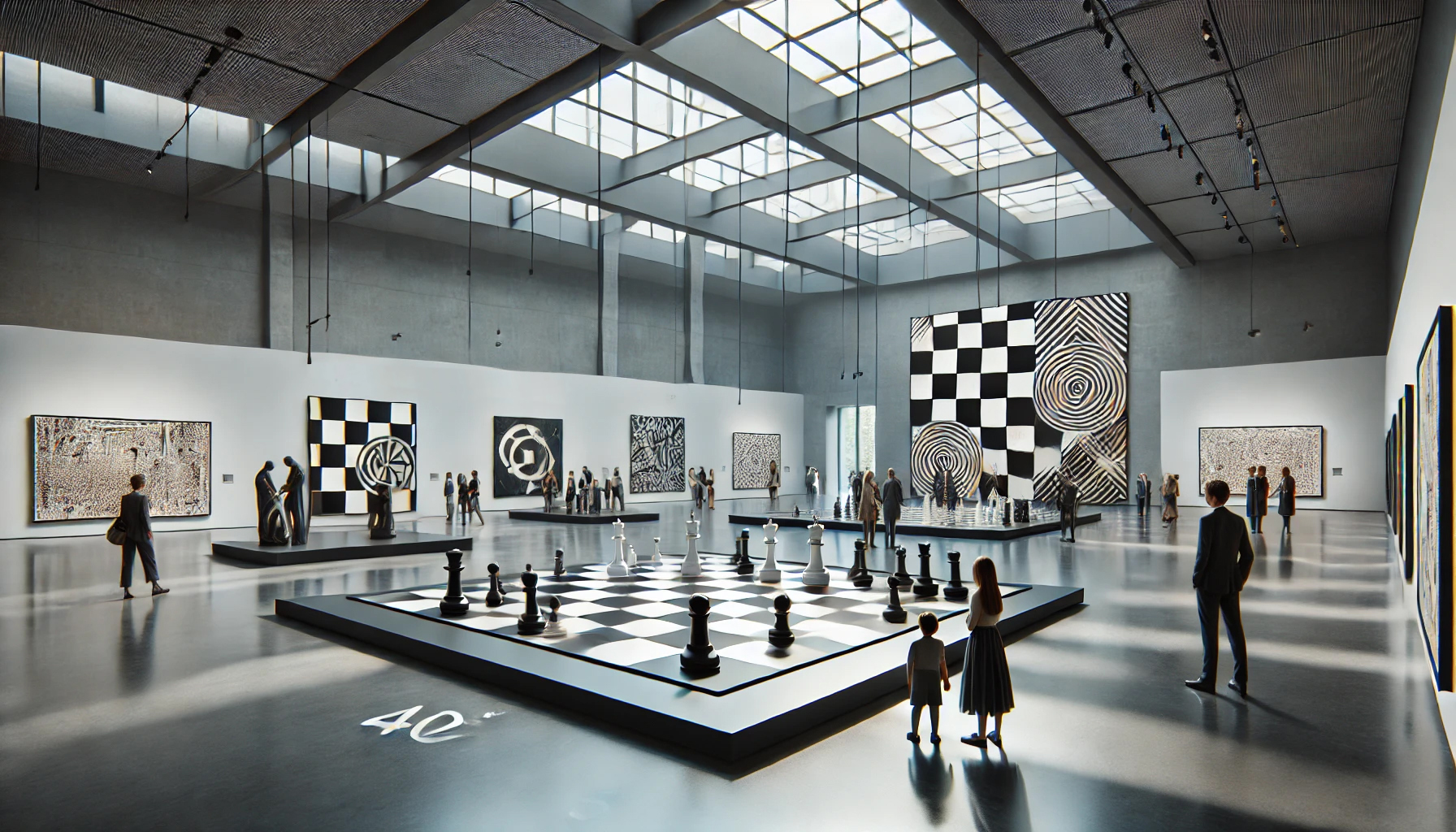
On first glance, ‘The Gold and Chessboard Problem’ by Dennis Ebert is a careful monumentalization of a classic Staunton chess set.
The format and the level of finish immediately stand out, but Ebert primarily regards the installation as a visualization of the core idea that got out of hand.
Anyone who takes the trouble to pause at the work will make a mathematical and economic journey, to arrive at social and psychological questions to which no unambiguous answer can be found.
“In secondary school I heard about ‘the wheat and chessboard problem’, the legend about the invention of the game of chess. This story about the power of exponential growth has never let go of me.
Through ‘Comedian’ by Cattelan I realized that value can create art. This led to the crucial insight that art is the medium that can make the abstract theory of exponential growth tangible.
Art is namely the perfect framework for contradictions: it can make a non-committal invitation that at the same time has consequences in the real world.”
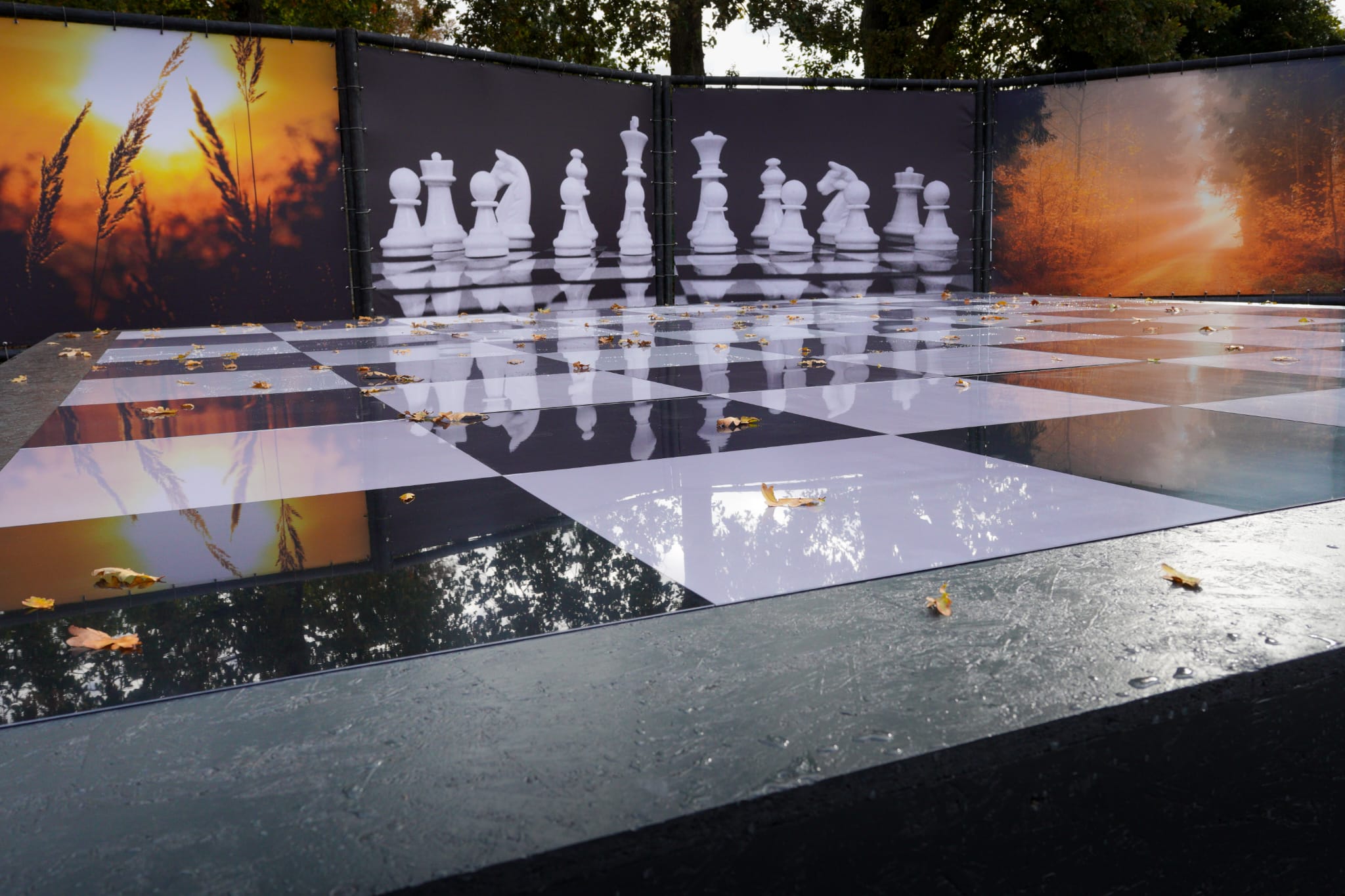
As an art form, ‘The Gold and Chessboard Problem’ is difficult to classify. The various aspects touch on multiple categories, and with that Ebert perhaps creates an entirely own category.
The life-size installation functions as a participatory artwork, with a unique dependence on public visibility and private ownership. Ebert himself describes it as a serial conceptual artwork:
“I like to go back to the basics. To the idea of selling the 64 squares of a chessboard as separate artworks, against the rising price scheme from the legend of the game of chess.
Everything that has come out of that is to ensure that people would take the trouble to look at the idea.
Although I gladly admit that it has grown into something much more beautiful than I initially had in mind. But the core is unchanged.”
Sold squares are removed from the artwork. Collectors therefore influence the physical composition and that makes them literally co-creators of the work.
According to Ebert a crucial aspect:
“Before the first sale this work was complete, but at the same time it is not finished without collectors.”
He of course means by this that the composition does not change without sales, but above all that the power and reality of the exponential growth do not come to life without the commitment of collectors.

The most recent reserved square: #10 for 512 grams of gold
Ebert acknowledges that his work is in fact dependent on his collectors. And that crucial contribution he wants to reward.
“Collectors influence the composition and show the power of the work. Without them it cannot exist. Together with me they are the co-creators and that is why I find it more than fair that I let them share in my revenues.”
About the distribution Ebert does not yet want to elaborate too much in terms of content.
“That technical information is currently only for intrinsically interested parties. And I have still some work to do about the legal side of it. Gold diggers can be found everywhere and I specifically want to work with people who are primarily touched by the artistic idea and the chance to create something beautiful together.”
And where does that reference to gold come from?
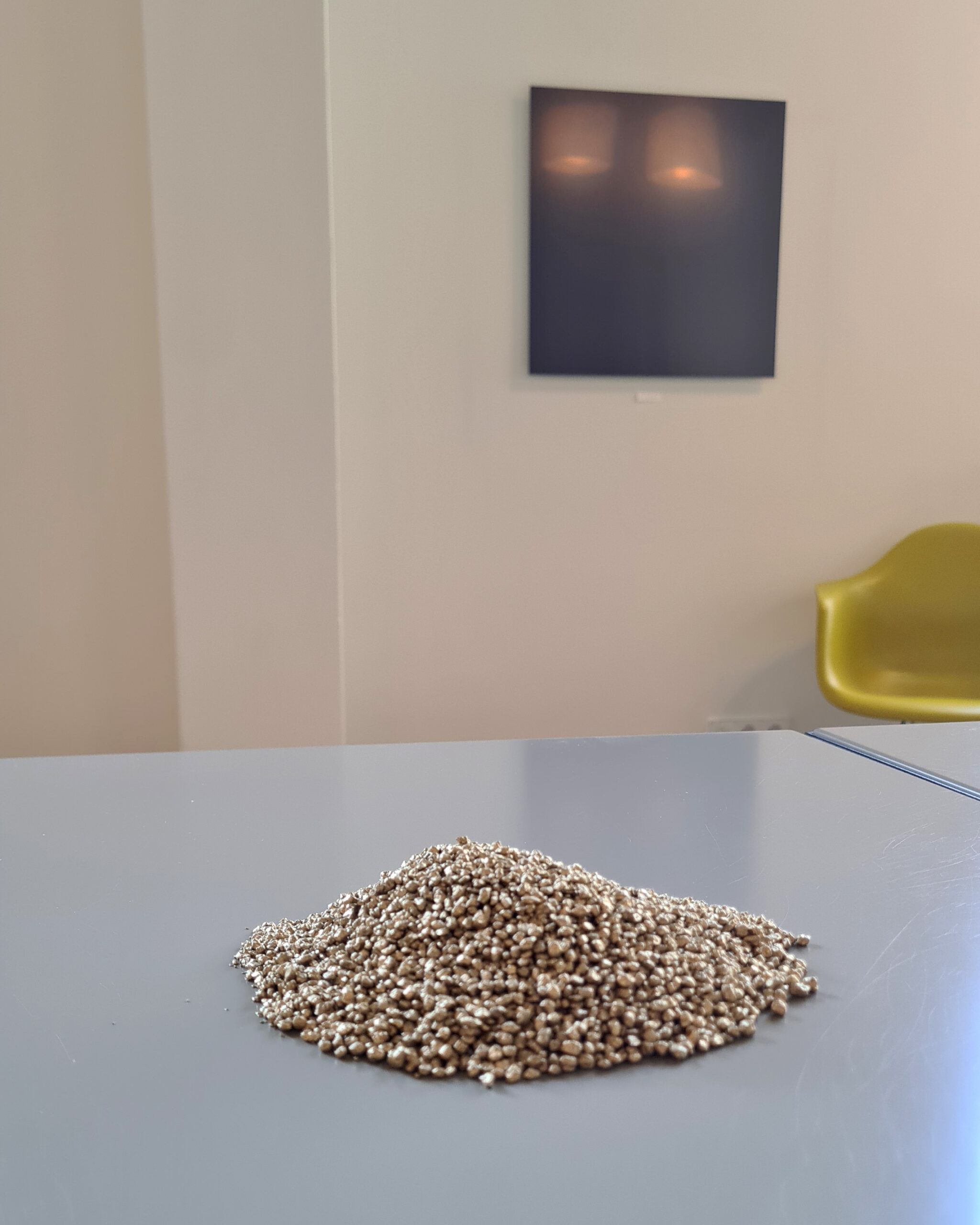
“I sell the squares in grams of gold. A gram of gold is approximately as large as a grain of wheat. This makes it a nice analogy with the legend, but it also ensures that everyone anywhere in the world and at any moment in time can understand the monetary value of the ecosystem.”
‘The Gold and Chessboard Problem’ is currently exclusively viewable by appointment in the area of Papendrecht, South Holland. Ebert is still looking for an appealing, public location for the work.
- - - - -
Pricing
Timelessness is an important subject of this artwork. Therefore my pricing is based on the gold standard.
With pricing based on the gold standard, future generations will be able to put the original sales price of these artworks into perspective with their modern day currency.
The currencies on this website are indicative. Actual prices of artworks are determined by the weight in gold shown and the trading rates on the day of the transaction. See https://goldprice.org/ for the current rates.
Customer research is mandatory for transactions exceeding €10,000 by Dutch national law (Wwft).
Social media
Follow this project on social media (the first button is this artworks’ project page; the second button is Dennis’ personal Instagram)